
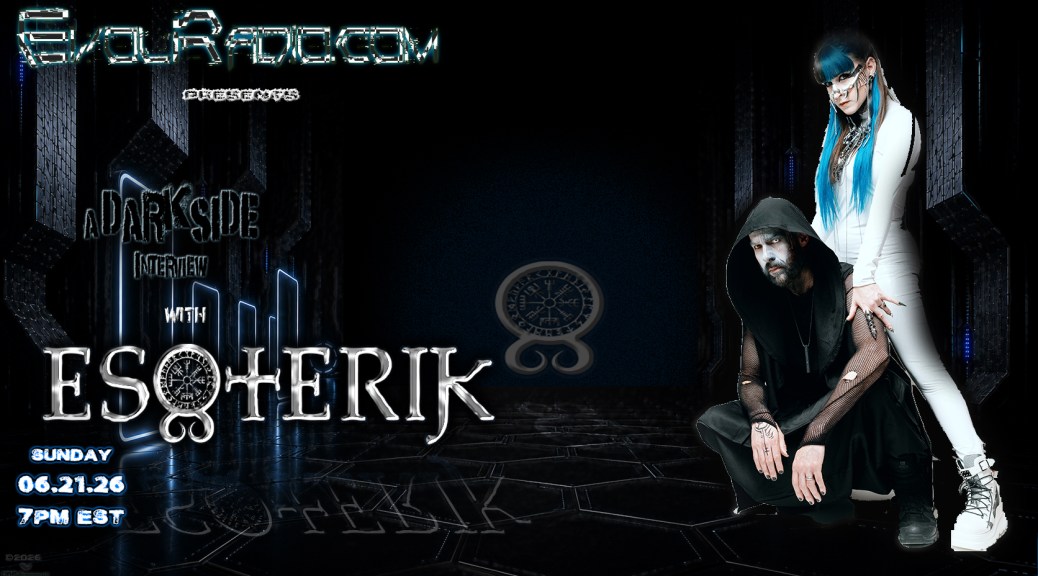
Fueled by emotional honesty, crushing guitars, and industrial intensity, Esoterik are no longer simply evolving — they’re transforming everything they once were into something louder, darker, and far more human.
For years, Esoterik have existed in the shifting space between dark electro, industrial rock, cinematic atmosphere, and emotional confrontation. Their sound has continuously evolved, moving through electronic textures, aggressive rhythms, haunting melodies, and alternative darkness without ever fully settling into a single identity. Yet despite every transformation, one thing has remained constant: Esoterik has always been about two creative minds translating emotion, memory, and human experience into sound.
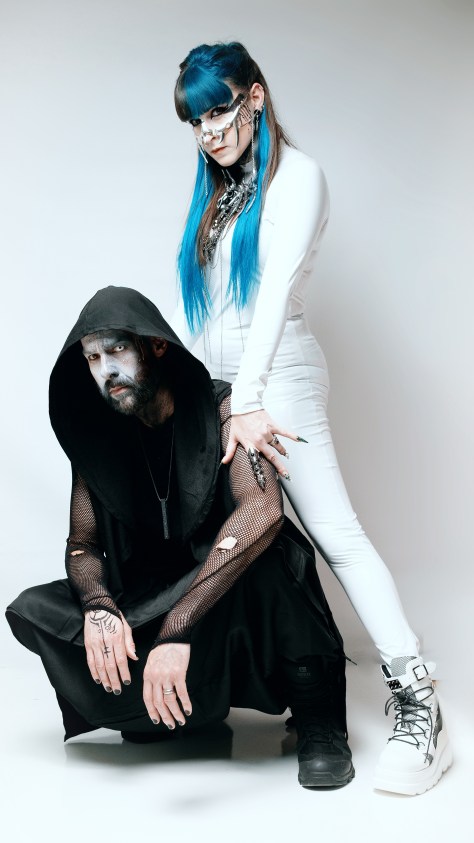
At the heart of the project are Allison Eckfeldt and Brady Bledsoe — creative partners whose artistic chemistry has become almost instinctual over time. What separates Esoterik from many projects navigating similar territory is that their evolution never feels calculated. Nothing about this newer era sounds like trend-chasing or reinvention for survival. Instead, it feels like a natural unraveling of everything they’ve quietly been building toward for years.
The heavier direction began almost accidentally. Brady started writing material driven more by guitars than synths, initially without any intention of connecting it to Esoterik at all. Those early demos existed simply as creative experiments — something fun, raw, and instinctive. But the more time the duo spent with the material, the clearer it became that this sound belonged to the project’s future. By fusing electronic foundations from earlier releases with massive guitars, emotionally volatile vocals, and explosive rhythmic energy, Esoterik discovered a new sonic identity that still felt unmistakably their own.
That emotional authenticity remains the defining core of the band. Both Allison and Brady repeatedly return to the same creative philosophy: music should feel something. Not just sonically, but physically and emotionally. They chase the same emotional reactions music once gave them growing up — the chills, the fire, the catharsis, the songs that permanently attach themselves to memory. That pursuit shapes every creative decision they make.

For Allison, recording vocals becomes less about technical execution and more about immersion. Drawing from a background in theater, she approaches songs almost like emotional performances in a film, allowing herself to absorb the atmosphere of the instrumental before instinctively discovering the emotional tone the song demands. Her vocals can move from intimate vulnerability to explosive aggression within moments, but the transitions never feel forced because they come from a genuine emotional place rather than performance for performance’s sake.
Even lyrically, the duo avoid obvious storytelling. Allison intentionally leaves emotional space inside the songs for listeners to project themselves into the music. Rather than writing direct narratives about people or relationships, she gravitates toward abstract concepts, folklore, emotional states, existential questions, and larger philosophical ideas. The result is music that feels deeply personal while remaining universally interpretable.
Brady’s production philosophy mirrors that same human-first approach. In an era where modern production technology allows artists to quantize every imperfection into sterile precision, he actively resists losing the humanity underneath the machinery. Every Esoterik song begins on acoustic guitar before electronic production ever enters the picture, creating an organic emotional skeleton underneath the industrial textures. Instead of obsessing over perfect tones or textbook production techniques, Brady focuses on capturing momentum before inspiration disappears. That urgency gives Esoterik’s music its tension — a balance between mechanical aggression and emotional imperfection.

The current chapter of Esoterik is defined by empowerment, transformation, and reclaiming control. Allison describes the new material as a self-empowerment album built around the idea of refusing victimhood and reclaiming personal sovereignty. The themes running through the songs confront pain directly but refuse to stay trapped inside it. The message becomes one of survival, rebirth, and ownership over one’s own narrative.
No song represents that evolution more clearly than “Cycles,” the track both Allison and Brady identify as the defining statement of modern Esoterik. The song captures every element of what the duo have become — crushing heaviness, emotional volatility, electronic atmosphere, and aggressive catharsis colliding into something that feels simultaneously nostalgic and entirely new. For Allison, the track reconnects her to the exact feeling that inspired her to become a vocalist as a child listening to artists like Static-X, Fear Factory, Drain STH, and Black Sabbath.
That reconnection to heavier influences has become a major driving force behind the project’s future. Brady openly admits his longtime connection to the metal community played a major role in shaping the newer material. What surprises him most is not simply how naturally the transition happened, but how strongly audiences have responded to it during live performances. The aggressive direction has not alienated listeners — if anything, it has intensified the emotional connection between the band and its audience.
The visual identity evolving alongside the music reflects that same collision of eras and influences. The duo describe upcoming imagery inspired by 80s trad-goth aesthetics, 90s industrial culture, and 70s punk energy all fused together into something darker, sharper, and more confrontational. Future live performances may even expand beyond the current duo format, introducing additional members to fully realize the scale and aggression of the new material on stage.
At the same time, Esoterik remain deeply aware of the modern pressures surrounding music and content creation. Both Allison and Brady openly acknowledge the exhausting reality artists now face — balancing constant visibility, algorithms, social media, branding, and content demands while still protecting the emotional authenticity that made them artists in the first place. Neither of them pretend to have perfected that balance. Instead, they focus on staying honest, creating work they genuinely believe in, and refusing to let metrics define their worth.
That mindset may ultimately define Esoterik more than any genre label ever could. Their music no longer exists comfortably inside industrial, darkwave, alternative metal, or electronic boundaries alone. It exists somewhere between all of them — emotionally raw, rhythmically aggressive, cinematic, cathartic, and unapologetically human.
Esoterik are not abandoning who they once were.
They are becoming the loudest, most emotionally fearless version of themselves yet.

Deep Dive into the Universe of Esoterik
Official Website – Facebook – Instagram – YouTube – Spotify – Bandcamp
 Your source for Dark/Alt/Dance culture on EvolRadio.com- with DJ Darkside